What is Platelet Apheresis?
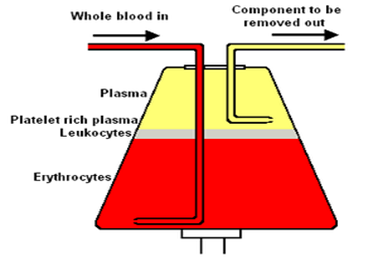
 Until recently, the only way to collect enough platelets for a single transfusion was to take blood donations from 5 to 10 donors, separate the platelets from the other blood cells, and combine the platelets to obtain a large enough quantity for transfusion. Today, sophisticated medical equipment — blood cell separators — can collect enough platelets for transfusion from a single donor. Using a technique called apheresis, blood is drawn from the donor's vein into an apheresis instrument, which separates the blood into separate portions by centrifugation.
By appropriately adjusting the instrument, a selected portion of the blood, such as the platelets, can be recovered, while the rest of the blood is returned to the donor either into the same vein or into a vein in the other arm.
This process takes more time than whole blood donation, but the percentage of platelets is much greater. It is a simple, safe process — very much like regular blood donation. In fact, your body starts replenishing platelets immediately after your donation. Within 48 hours, your body's platelets should be completely replenished.
| Attachment | Size |
|---|---|
 apheresis.png apheresis.png | 29.22 KB |